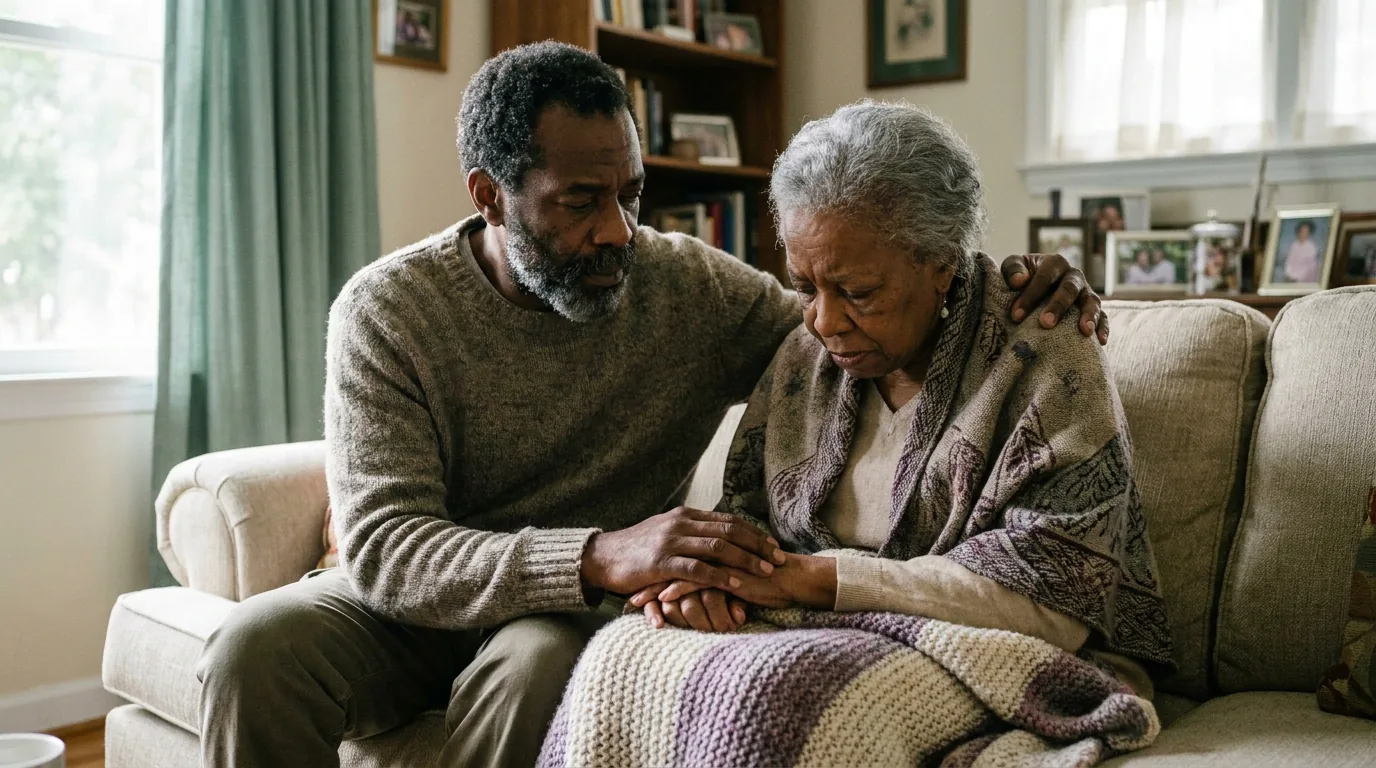
Six months after the funeral, people stop asking how you are doing. You are still waking up some mornings and, for half a second before it lands again, forgetting that they are gone.
Maybe it has been longer than six months — a year, three years — and you have started to wonder if there is something wrong with you for still feeling this. There is not. Grief does not run on a schedule, and it rarely follows the tidy path people describe at the funeral home. If you are searching for grief counseling in Akron, Stow, or anywhere in Summit County, you are likely not looking for someone to tell you to move on. You are looking for a place to put this down, even for fifty minutes, with someone who has done this work for a long time.
Grief Does Not Move in a Straight Line
Most people have heard of the five stages of grief — denial, anger, bargaining, depression, acceptance — and many quietly blame themselves for not moving through them in order, or for landing back on anger after they thought they had reached acceptance. That self-judgment is not necessary. The American Psychological Association notes there is no "normal" time period for grieving, and that research suggests most people do not move through predictable, sequential stages at all — grief tends to arrive in waves, shaped as much by your relationship to the person you lost as by any timeline (APA).
What research does show is that most people are able to move through loss over time, especially with steady social support and basic self-care in place (APA). For some people, that happens with time, family, and community. For others — especially when the loss was sudden, violent, or layered onto other stress — it does not happen on its own. That is not a personal failing. It is a sign the grief needs more support than it is currently getting.
When Grief Becomes Something More
Grief that stays this intense for a long stretch of time has a name. Mayo Clinic describes complicated grief as an ongoing, heightened state of mourning that does not soften the way ordinary grief symptoms typically do — instead of gradually fading, the symptoms linger or get worse (Mayo Clinic). The clinical term is prolonged grief disorder, added to the DSM-5-TR — the manual clinicians use to diagnose mental health conditions — in 2022. The American Psychiatric Association describes it as intense longing for the person who died, difficulty accepting the death, avoidance of reminders, emotional numbness, and a sense that life has lost its meaning, present nearly every day for at least a month, when the loss happened at least a year ago for an adult, or six months ago for a child or teenager (American Psychiatric Association). It is more common than most people realize: an estimated 4 to 15 percent of bereaved adults experience it (American Psychiatric Association).
If this sounds like where you are, please do not read it as proof that you are broken. It exists as a description so you can be treated for what you are actually carrying, instead of being told to give it more time.
If you are having thoughts of harming yourself or of not wanting to be here, please call or text 988 to reach the Suicide & Crisis Lifeline — free, confidential, and available around the clock.
How Grief Counseling Actually Helps
Grief counseling is not about being told to "let go," or to be grateful for the time you had. It is a structured, private space for the things that do not fit anywhere else — the guilt, the relief, the anger at the person for dying, the anger at people who did not understand, the fear of forgetting their voice.
Sessions draw on cognitive behavioral therapy, a trauma-informed approach, and, when a loss is affecting the whole household and not just one person, a family-systems lens. A 2024 review in the journal Behavior Therapy found moderate evidence that grief-focused cognitive behavioral therapy outperforms other forms of psychotherapy for prolonged grief, with effects that held up — and grew — at follow-up (Behavior Therapy, 2024). That does not mean therapy erases grief or puts it on a deadline. It means there are real, studied tools for grief that has become stuck, and this practice draws on the ones with the strongest evidence behind them.
Your therapist has worked with grieving clients since 2003 — in English and in Español — and has sat with hundreds of people carrying versions of exactly what you are carrying now. Some clients feel a shift by the third session. Others need longer. Both are normal.
If you are ready to talk to someone, book a free 15-minute consultation. There is no pressure attached to that call. It is a chance to describe what is going on and ask whatever you need to ask before committing to anything.
What Happens in Your First Session
The first session is mostly you telling the story on your own terms — what happened, when, what has helped so far, and what has not. Expect some background questions and a check-in on your safety, followed by a conversation about what you would actually like to be different. You will not be asked to relive the worst of it in the first fifty minutes, and you will not leave with homework you did not agree to.
Grief Counseling en Español, Too
Grief is hard enough to talk about in your first language. If English is not the language you grieve in, you should not have to do this work in translation. Sessions are available fully in Spanish as well as English — a genuine option, not an interpreter add-on — for individuals and families across Summit County. Read more about bilingual therapy at the practice.
Serving Stow, Akron, Hudson, Cuyahoga Falls & All of Summit County
The office is at 3653 Darrow Rd, Ste 5, in Stow, seeing clients Tuesday through Thursday, 6 to 9 p.m. — hours built for people who work during the day. Clients come from Akron, Hudson, Cuyahoga Falls, and elsewhere in Summit County, and telehealth sessions are available anywhere in Ohio or Florida, which matters if grief has made it hard to imagine getting in the car some days.
If the loss has unsettled the whole family, not just you, family therapy is also available, and a trauma-informed approach runs throughout the practice, since grief and trauma frequently travel together. Read more about trauma-informed care here.
On Cost: Fees & Insurance
This practice accepts insurance and is in-network with many major plans — including Aetna, Cigna, Medical Mutual, and UnitedHealthcare, along with Medicare and Medicaid — and the billing team files claims with your insurer directly. Self-pay is also available: $145 for the first, longer session, and $135 for each session after, with a $75 fee for missed appointments without notice. If your plan is one we are not in-network with, a superbill is provided after each session so you can seek reimbursement directly from your insurer. Full detail on rates and superbills is on the fees page.
Self-pay remains available for anyone who prefers it, and for grief specifically it carries a real advantage: no diagnosis has to be attached to your file just to talk to someone about a death. Choosing self-pay means you decide what gets discussed and for how long, with no utilization review deciding when you are "done" grieving.
Not ready to book yet? That is fine. Two things worth reading first: How Long Does Grief Last? and When Grief Doesn't Ease: Understanding Complicated Grief. Or send a question through the contact form — there is no obligation to book anything.
When you are ready, book a free 15-minute consultation and talk through what is going on and whether this is a good fit.